Seiko Limited Edition Diver’s Prospex Black Series ‘Sumo’ Solar Black Dial Silicone Strap Men's Watch SSC761J1
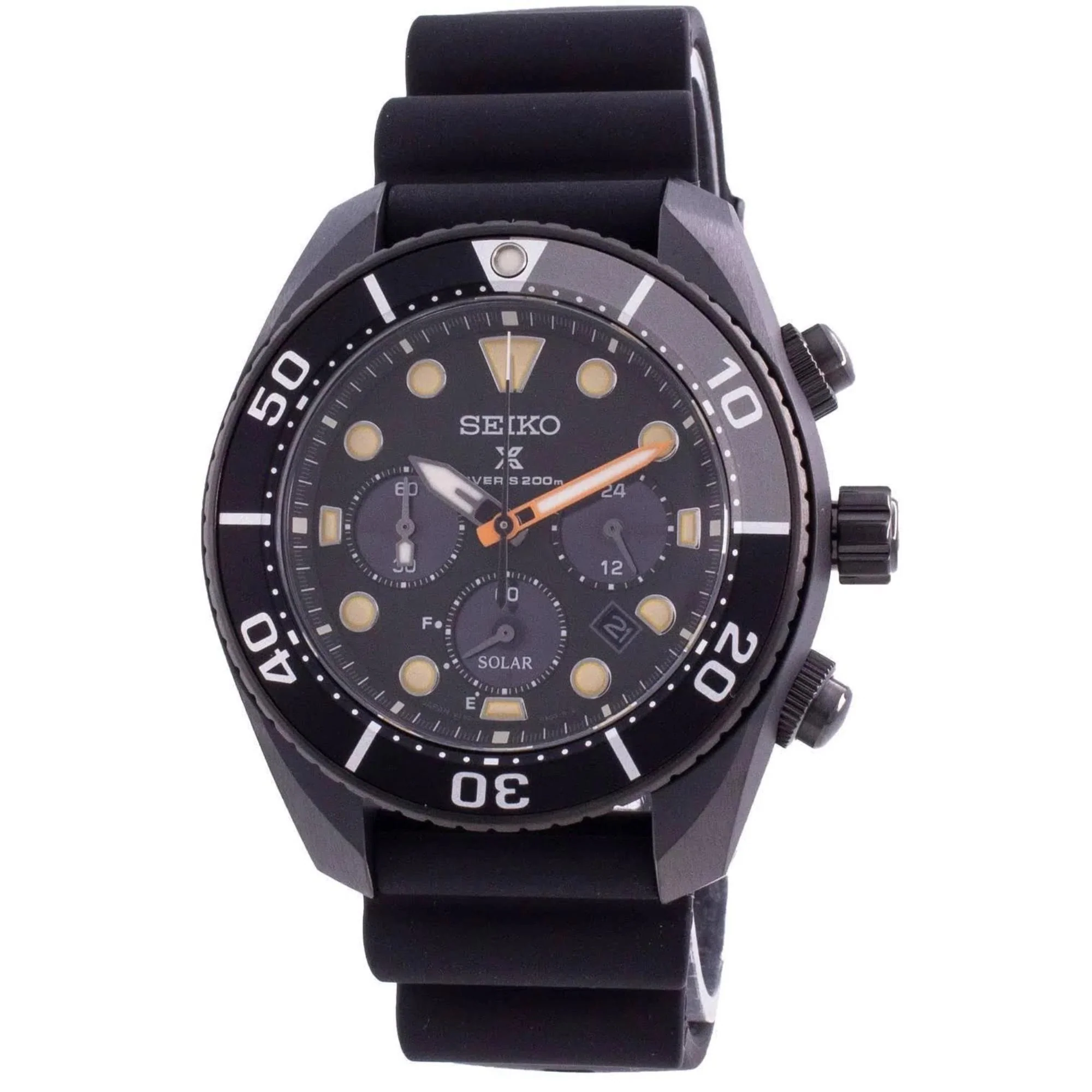
Seiko Limited Edition Diver’s Prospex Black Series ‘Sumo’ Solar Black Dial Silicone Strap Men's Watch SSC761J1
Seiko Limited Edition Diver’s Prospex Black Series ‘Sumo’ SSC761J1
History:
Style:
This watch combines practical functions of a wristwatch with the waterproof functions of air diving. It is part of the Black series, of which more information can be found here. This model in particular has a limited number of just 3,500 which is serialized on the case back. The impressionable orange accent of its design also make these watches perfect for daily use. Black hard-coating is applied to the stainless steel case of the watch whose design has long been popular amongst wearers by the nickname "SUMO." The orange of the minute hand echoes the light flashed in the dark sea by the night divers which allows for the exact time to be read under dark conditions. Finally, a black silicone strap which has an accordian style can be fastened using a standard buckle.
Functions:
Made In Japan:
For all you Seiko enthusiasts, this premium timepiece has been made and produced in Japan, indicated by the suffix ‘J’. Seiko watches made in Japan are notoriously hard to obtain outside of Japan due to the highest quality of craftsmanship and astonishing features that come in each timepiece. We have a range of Japanese watches here at Watchnation but in limited quantities, so if you are looking to add to your collection then this is the perfect place for you.
Key Features:
| V192 Caliber | Solar Movement | +-15 Seconds Per Month |
| Stainless Steel Case | Hard Coating | Sapphire Crystal |
| LumiBrite | Silicone Strap | 200m Water Resistant |
| Thickness: 13.7mm | Diameter: 44.5mm | Length: 51.6mm |
| 207mm Bracelet Perimeter | LIMITED EDITION On Case Back | Screw Case Back |
| Screw Down Crown | Serial Number On Back | Unidirectional Bezel |
| 24 Hour Hand | Chronograph | Date Display |
| Resuming Electric Power Generation | Overcharge Prevention | Small Seconds Hand |
The Prospex Story:
Scuba-diving became increasingly popular around the 1960’s, an example of this was the formation of the Professional Association of Diving Instructors (PADI) in 1965. Diving equipment was becoming increasingly reliable, so more people began to dive recreationally. There was of course a crucial need for divers to be able to time their dives. Subsequently, the watch market responded to this necessity by flooding the market with dive watches.
In 1965, Seiko first produced their original dive watch - the 6217. This was the first Japanese dive watch and it paved the path for future divers that claim to meet Seiko’s Professional Specifications. The original 6217 was notably worn by the 8th Japanese Antarctic expedition. This model featured bidirectional rotating bezel, distinctive and lumed hands, and an easy-to-grip crown.
Although professional divers were still pining for a dive watch that had the capability of going deeper than 300 metres. The Seiko team went about going to produce a watch which was capable of doing so. 1975 marks the release of the first Seiko Prospex, with the ability to be used in 600 metre depth. It's first diver watch to use a titanium case instead of a steel case. It was also the first to use a ceramic shroud for diving and the first to use a hybrid analog digital watch with an alarm.
Another achievement for the Prospex family was the L-shape single crystal gasket, which prevented any helium escape. This was one of the development teams first aims. There were numerous other milestones that Seiko achieved with the Prospex. Such as in 1986 when Seiko produced a watch that was water resistant to 1000 metres.
The Brand: Seiko
Seiko’s story began in 1881 with the opening of a shop in Tokyo. Eleven years after the opening of his shop, Hattori opened a clock factory and in 1895 that they began to produce pocket watches. Soon followed by alarm clocks in 1899, and then table clocks in 1902. Then in 1913 Hattori began working on his first wristwatch. Then in 1924, 43 years after the initial opening, Seiko was born with the creation of the first wristwatch.
Seiko established itself throughout the 20th century as being a force in the advancements that took place in the watching world. For example, Seiko were the producers of the first winding wristwatch made in Japan. Then in 1964, Seiko became the official timer for the Olympics. And then most notably Seiko unveiled the first quartz wristwatch, the Astron, in 1969. Marking the beginning of the quartz revolution. Or equally impressive the creation of the world’s first TV watch in 1982. And even more relevant today, with our abhorrent use of non-renewable energy sources, Seiko’s Kinetic. This watch had the ability to generate its own power from the movement of the wearer.
Ceaseless determination to innovate in every aspect of the watchmaker’s art is what defines Seiko’s history. By embracing this ethos, Seiko has been responsible for a string of advances in the technology of time. The listed technological developments serve as evidence to illustrate the revolutionary impact which Seiko has had on the watchmaking world. They are also remarkably unique in that they manufacture every aspect of every watch in-house.
Links:
Product Information
Product Information
Shipping & Returns
Shipping & Returns
Description
Seiko Limited Edition Diver’s Prospex Black Series ‘Sumo’ SSC761J1
History:
Style:
This watch combines practical functions of a wristwatch with the waterproof functions of air diving. It is part of the Black series, of which more information can be found here. This model in particular has a limited number of just 3,500 which is serialized on the case back. The impressionable orange accent of its design also make these watches perfect for daily use. Black hard-coating is applied to the stainless steel case of the watch whose design has long been popular amongst wearers by the nickname "SUMO." The orange of the minute hand echoes the light flashed in the dark sea by the night divers which allows for the exact time to be read under dark conditions. Finally, a black silicone strap which has an accordian style can be fastened using a standard buckle.
Functions:
Made In Japan:
For all you Seiko enthusiasts, this premium timepiece has been made and produced in Japan, indicated by the suffix ‘J’. Seiko watches made in Japan are notoriously hard to obtain outside of Japan due to the highest quality of craftsmanship and astonishing features that come in each timepiece. We have a range of Japanese watches here at Watchnation but in limited quantities, so if you are looking to add to your collection then this is the perfect place for you.
Key Features:
| V192 Caliber | Solar Movement | +-15 Seconds Per Month |
| Stainless Steel Case | Hard Coating | Sapphire Crystal |
| LumiBrite | Silicone Strap | 200m Water Resistant |
| Thickness: 13.7mm | Diameter: 44.5mm | Length: 51.6mm |
| 207mm Bracelet Perimeter | LIMITED EDITION On Case Back | Screw Case Back |
| Screw Down Crown | Serial Number On Back | Unidirectional Bezel |
| 24 Hour Hand | Chronograph | Date Display |
| Resuming Electric Power Generation | Overcharge Prevention | Small Seconds Hand |
The Prospex Story:
Scuba-diving became increasingly popular around the 1960’s, an example of this was the formation of the Professional Association of Diving Instructors (PADI) in 1965. Diving equipment was becoming increasingly reliable, so more people began to dive recreationally. There was of course a crucial need for divers to be able to time their dives. Subsequently, the watch market responded to this necessity by flooding the market with dive watches.
In 1965, Seiko first produced their original dive watch - the 6217. This was the first Japanese dive watch and it paved the path for future divers that claim to meet Seiko’s Professional Specifications. The original 6217 was notably worn by the 8th Japanese Antarctic expedition. This model featured bidirectional rotating bezel, distinctive and lumed hands, and an easy-to-grip crown.
Although professional divers were still pining for a dive watch that had the capability of going deeper than 300 metres. The Seiko team went about going to produce a watch which was capable of doing so. 1975 marks the release of the first Seiko Prospex, with the ability to be used in 600 metre depth. It's first diver watch to use a titanium case instead of a steel case. It was also the first to use a ceramic shroud for diving and the first to use a hybrid analog digital watch with an alarm.
Another achievement for the Prospex family was the L-shape single crystal gasket, which prevented any helium escape. This was one of the development teams first aims. There were numerous other milestones that Seiko achieved with the Prospex. Such as in 1986 when Seiko produced a watch that was water resistant to 1000 metres.
The Brand: Seiko
Seiko’s story began in 1881 with the opening of a shop in Tokyo. Eleven years after the opening of his shop, Hattori opened a clock factory and in 1895 that they began to produce pocket watches. Soon followed by alarm clocks in 1899, and then table clocks in 1902. Then in 1913 Hattori began working on his first wristwatch. Then in 1924, 43 years after the initial opening, Seiko was born with the creation of the first wristwatch.
Seiko established itself throughout the 20th century as being a force in the advancements that took place in the watching world. For example, Seiko were the producers of the first winding wristwatch made in Japan. Then in 1964, Seiko became the official timer for the Olympics. And then most notably Seiko unveiled the first quartz wristwatch, the Astron, in 1969. Marking the beginning of the quartz revolution. Or equally impressive the creation of the world’s first TV watch in 1982. And even more relevant today, with our abhorrent use of non-renewable energy sources, Seiko’s Kinetic. This watch had the ability to generate its own power from the movement of the wearer.
Ceaseless determination to innovate in every aspect of the watchmaker’s art is what defines Seiko’s history. By embracing this ethos, Seiko has been responsible for a string of advances in the technology of time. The listed technological developments serve as evidence to illustrate the revolutionary impact which Seiko has had on the watchmaking world. They are also remarkably unique in that they manufacture every aspect of every watch in-house.